The Challenge
The door had survived a hundred years in a Gothic Revival stone home in Wyndmoor — leaded glass windows, carved limestone surround, marble threshold. Everything about the house was built to last. But the carved oak tracery header at the top of the double door had finally failed: cracked through, joints open, the hand-carved Gothic cusps and foliate rosette too far deteriorated to repair in place.
The panels needed full disassembly and restoration. The joinery throughout needed attention. And the header — the most architecturally significant piece of the door, the thing that made it unmistakably of its era — could not be sourced anywhere. It hadn't been manufactured in generations. The profiles, the cusped ogee arches, the specific tracery geometry — these were custom to this house.
The options were: replace the door entirely with something generic, or hand-carve a new header to match. There was only one acceptable answer.
Before
The Door, Disassembled
The first step was getting the door off its hinges and broken down into its component parts — panels, stiles, rails, and the carved header — so each element could be assessed independently. Seeing a door like this laid flat on the workbench is a different kind of reading. You see where the wood has moved, where moisture got in, where old repairs were made, and where the original craftsmanship still holds.
The panels themselves were structurally sound. The original oak, dense and slow-grown, had held up remarkably well. The joinery was the primary issue — decades of seasonal movement had opened the mortise-and-tenon joints, and the carved header had cracked along its grain. The brass hardware, original to the door, was cleaned and preserved for reinstallation.
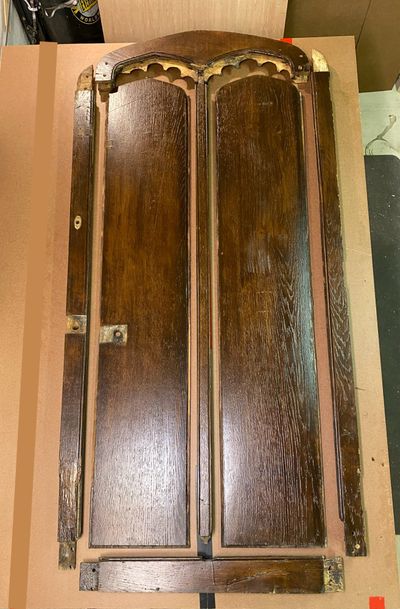
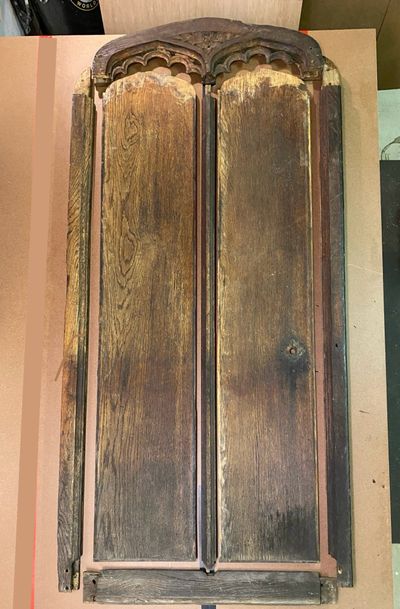
The door fully disassembled for assessment. Gothic arch double door with original brass hardware and hand-carved tracery header — Wyndmoor Gothic Revival home.
The carved header — the arched piece with the Gothic cusps, lancet moldings, and central foliate rosette — told the clearest story. Someone had cut it with real knowledge of Gothic Revival ornament: the cusp profiles were crisp, the geometry of the lancet arches precise, the rosette carved with a naturalism that takes time and skill to achieve. This wasn't stock millwork. It was designed and executed specifically for this door, likely by a craftsman who knew what he was doing.
That made the decision to replicate rather than replace easy to justify — and harder to execute.
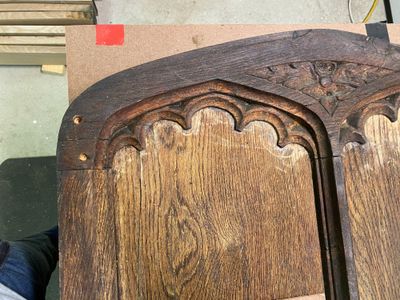
Original carved tracery detail — Gothic cusps, ogee arches, and foliate corner carving. The geometry had to be measured and replicated precisely in the new header.
The carved header couldn't be sourced. It hadn't been manufactured in generations. Every cusp, every ogee, every inch of that rosette had to be studied and re-cut by hand in matching white oak. — Fred Beese, Fred Beese Builds
The Work
Replication, Step by Step
Replicating historic carved millwork isn't a matter of tracing and cutting. The original was hand-carved — which means it has irregularities, tool marks, and subtle variations that give it life. A purely mechanical copy would look dead next to it. The goal is to understand the carver's intent, match the geometry, and execute the cuts with the same kind of judgment the original maker used.
Study & Measure
Every element of the original header was measured and documented: cusp depths, ogee radii, tracery geometry, rosette petal count and relief depth.
Template & Layout
Templates were made from the original profiles. White oak stock was selected to match the grain direction and density of the original. Layout lines were drawn full-scale.
Rough Cut & Shape
Band saw and router work established the major forms — the arch profile, the basic cusp shapes, the lancet geometry — before hand tools took over.
Hand Carve & Refine
Chisels and gouges brought the tracery and rosette to life. Each cusp undercut, each petal defined, each transition between forms refined until the new piece read as a match to the original.
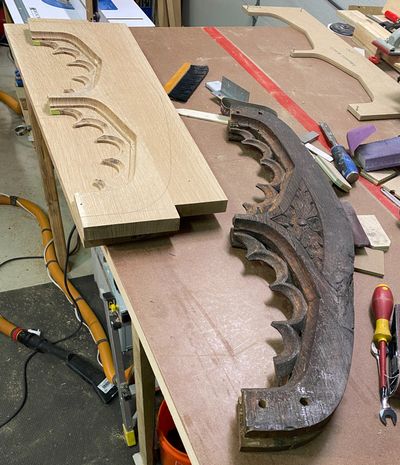
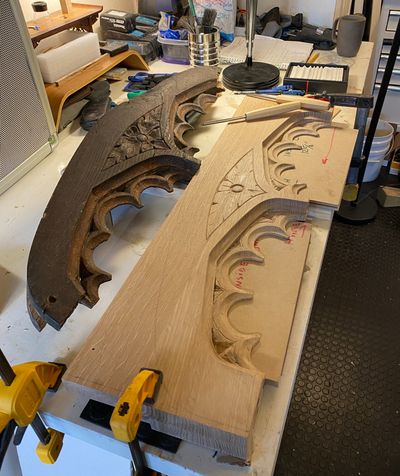
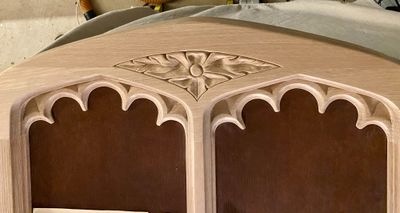
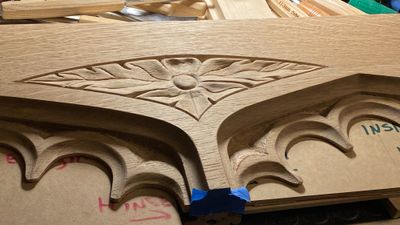
Left: the original carved header beside the new white oak replication in progress. Right: the new carving taking shape — the lancet geometry and cusp profiles matching the original.
The Detail
The Rosette & Tracery
The central foliate rosette — a symmetrical eight-petal flower carved in relief within a diamond-shaped field at the apex of the arch — was the most demanding element. In the original, the petals had a naturalistic curve and depth that took the carver real time to achieve. Matching it required working from observation, not just measurement.
The cusped tracery running along the arch was carved to match the original's rhythm exactly: the number of cusps, their spacing, the depth of the undercut that gives each one its three-dimensional presence. When held side by side with the original, the new carving reads as its twin — same hand, same eye, different century.
The completed tracery arch (left) and central rosette closeup (right). The rosette required hours of hand carving to match the naturalistic depth and petal form of the original.
When held side by side with the original, the new carving reads as its twin. Same hand, same eye — different century. — Fred Beese, Fred Beese Builds
After
Reinstalled, As If Untouched
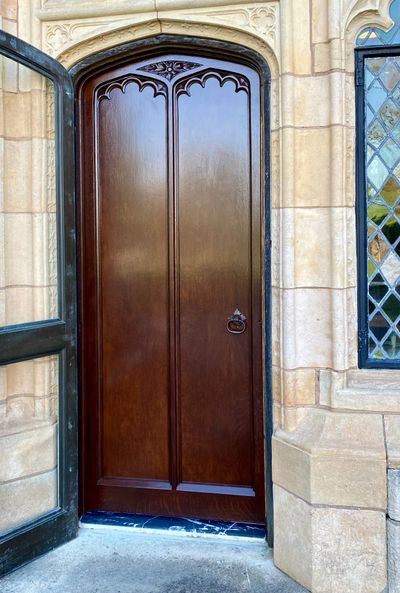
The restored panels and new header were finished to match the original's color and sheen, then reinstalled in the stone surround. The original brass hardware — cleaned and polished — went back in its original locations. The marble threshold, the carved limestone arch above, the leaded glass sidelights: everything that had always been there was still there. The door simply looked like itself again.
That's the measure of a successful historic restoration. Not that you can see the work — that you can't.
The finished door reinstalled in the original stone surround — Gothic Revival home, Wyndmoor PA. Carved limestone arch, leaded glass, marble threshold. The door looks as it always should have.
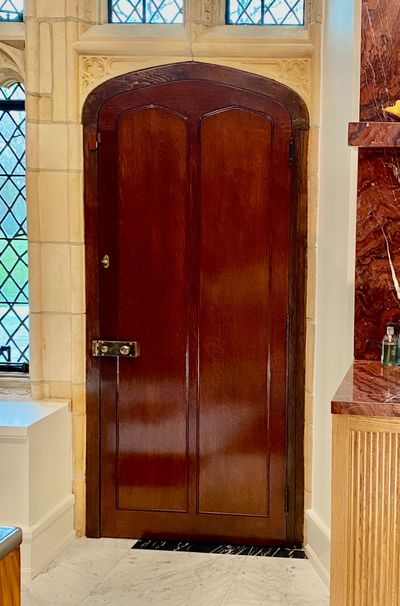
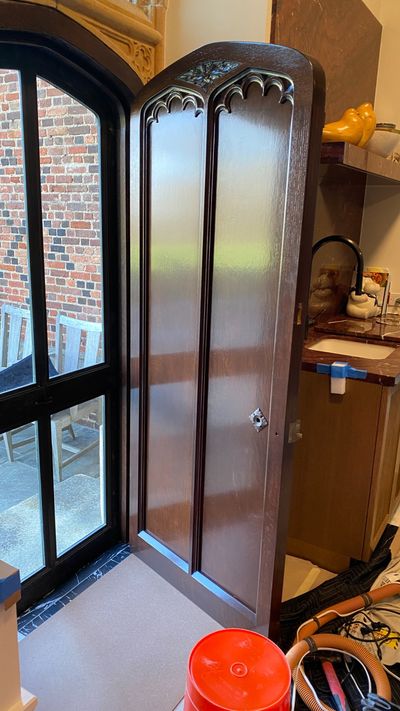
Interior views of the completed restoration. The new tracery header, finished and installed, is indistinguishable from the original work around it.