The Challenge
A historic stone chapel in the Blue Bell / Fort Washington corridor of Montgomery County held two sets of remarkable doors: Gothic-pointed-arch double doors with distinctive chevron (herringbone) plank patterns, set in beautiful brownstone voussoirs and fitted with leaded-glass transoms above. The doors were original to the chapel — likely built in the early 1900s — and hung on ornate wrought iron strap hinges, scrollwork hardware that had been part of the building since its construction.
But the doors were failing. Decades of moisture wicking up from the stone threshold and foundation had slowly deteriorated the bottom rails and lower stiles from the inside out. The rot was structural — not a cosmetic issue but a threat to the door's ability to function at all. The bottom rail joints were compromised. Wood fibers had disintegrated. Without intervention, the doors would soon become unusable.
This was institutional building work, not a residential project — which meant understanding not just the doors themselves, but how they functioned within a stone masonry envelope and what the building's long-term needs were.
Before
Moisture Damage in Stone Masonry
The primary issue with doors installed in stone buildings — especially old stone buildings with stone thresholds — is moisture wicking. Water draws up through porous stone from below and moves laterally into the wood. Over years or decades, this systematic moisture exposure deteriorates wood fibers from the inside out. The damage isn't always visible from the surface. A door can look sound while the interior wood is becoming mushy and compromised.
In the chapel doors, the rot had progressed to the point where the bottom rails (the horizontal members at the base of the door) and the lower portions of the stiles (the vertical side members) had become unstable. Wood near the joinery was spongy. The structural integrity of the joints was failing. Any additional stress — repeated opening and closing, seasonal wood movement, wind load — risked catastrophic failure of the entire door assembly.
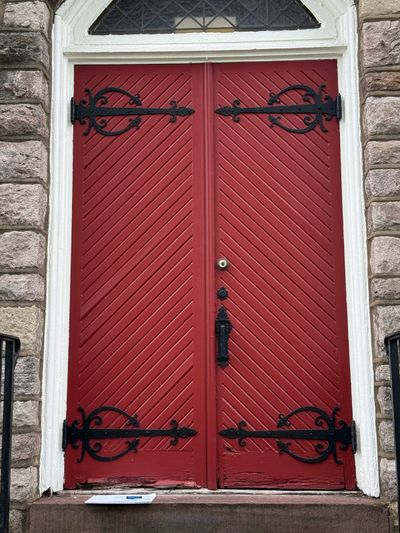
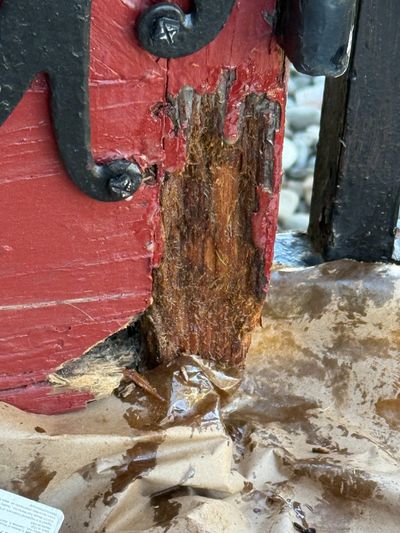
Pre-restoration condition: Both sets of chapel doors showing rot damage at the base and lower stiles. The ornate wrought iron strap hinges remained sound. The chevron plank pattern was intact but the supporting structure below was severely compromised.
The initial assessment meant removing the doors from their hinges and bringing them to the workshop to get a full picture of the damage. Once the doors were laid flat and examined, the extent of the problem became clear. This wasn't a repair that could be done in place. The doors needed to be fully disassembled, the rotted material excavated, the structural elements rebuilt or consolidated, and then the entire assembly refinished and reinstalled.
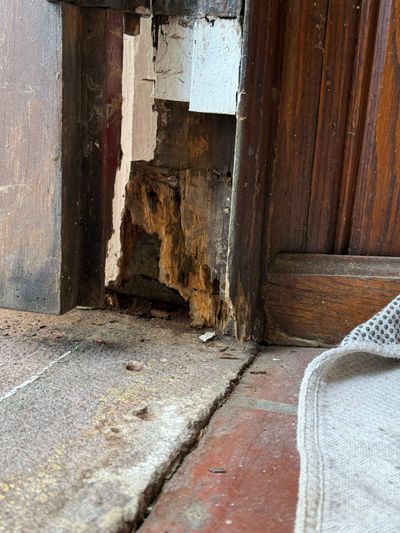
Interior view showing the extent of rot at the door frame. Moisture had penetrated deeply into the lower stiles and bottom rail, leaving wood fibers compromised and unable to support structural loads.
The damage wasn't visible until we started dismantling the door. The bottom rails were spongy — decades of moisture wicking from the stone had turned what should have been solid oak into something that crumbled under finger pressure. This is what moisture does to wood in stone buildings. You fix the wood damage or you replace the doors. — Fred Beese, Fred Beese Builds
The Work
Structural Repair, Not Just Cosmetic Fix
The restoration process required approaching the doors as structural elements, not just painted surfaces. The approach was methodical: disassemble the doors into component parts, assess each element, excavate and remove all deteriorated material down to solid wood, consolidate and stabilize remaining wood, then rebuild and refinish.
For the bottom rail rot, simply filling the voids with wood filler or patching compound wasn't an option. Wood filler sits in a hole like spackle in drywall — it doesn't bond to surrounding wood, doesn't stabilize compromised fibers, and fails under stress. The door would hinge and operate under real loading. The structural repair had to be proper.
Disassemble & Assess
Remove doors from hinges, lay out all components on the workbench, examine each element for rot, joint integrity, and structural soundness. Document damage patterns.
Excavate & Consolidate
Remove all deteriorated wood down to solid material. Use WoodEpox epoxy consolidant to stabilize remaining fibers. Unlike fillers, consolidant chemically bonds with wood and restores structural integrity.
Rebuild & Reinforce
For severely damaged areas, remove compromised material and splice in new wood matching species and grain direction. New epoxy hardware reinforces joints and ensures structural stability for decades of service.
Finish & Reinstall
Strip remaining paint, sand entire surface, apply primer and finish coats in traditional deep red. Clean and reinstall original wrought iron hardware. Rehang doors in their original stone surround.
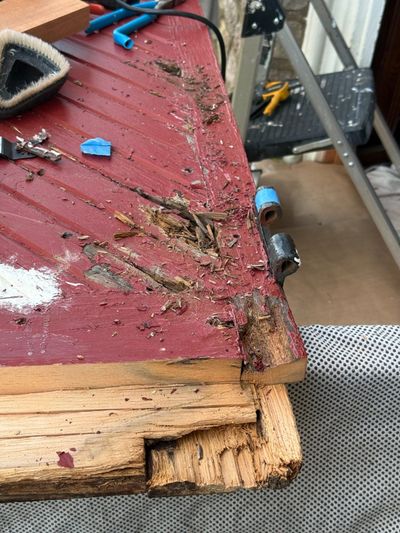
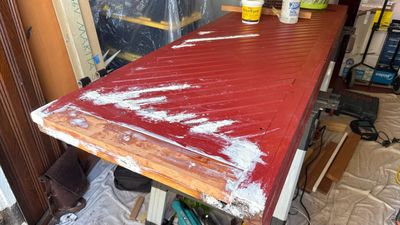
Left: Door panel on the workshop bench during rot excavation. Right: WoodEpox epoxy consolidant applied to stabilize remaining wood fibers. The white filler visible at the base is professional-grade structural epoxy, not simple wood putty.
The Detail
WoodEpox & Structural Integrity
The key material difference between a long-lasting restoration and a short-term patch is the consolidation method. WoodEpox is an epoxy consolidant made by Abatron — a professional-grade material used in institutional and historic building restoration. Unlike wood filler, epoxy consolidant penetrates into wood fibers at a molecular level, stabilizing and hardening the remaining solid wood while also filling voids.
When applied to deteriorated wood with proper technique, consolidant creates a wood-epoxy composite that's as hard and stable as the original wood. The bond is permanent. The structural element — a door bottom rail, for example — regains the strength to support loads and withstand the stresses of repeated opening and closing without future failure.
This is what separates professional historic restoration from DIY patching. Any woodworker or homeowner can slap filler in a hole. It takes proper training and materials to restore structural integrity in a way that will serve the building for another century.
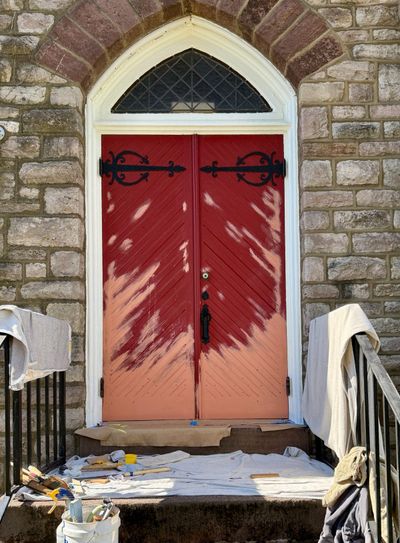
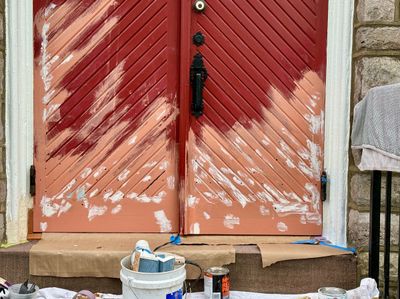
Mid-restoration: Doors sanded and repaired, ready for finishing. The original wrought iron strap hinges have been cleaned and are ready for reinstallation. The chevron plank pattern is clearly visible.
After
Restored & Ready for Service
Both sets of doors were restored to full functionality and returned to the chapel with their original wrought iron hardware reinstalled. The ornate strap hinges — which had survived perfectly intact despite the wood damage around them — now work with restored door assemblies. The chevron plank patterns, painted in the traditional deep red that speaks to the chapel's architectural character, are clear and uniform. The leaded glass transoms above sit in their original stone voussoirs exactly as they did a century ago.
The real measure of success is that the doors now function as they should — opening smoothly, closing firmly, protecting the interior from weather — and they'll continue to do so for decades to come. The structural restoration ensures that future moisture wicking won't be able to compromise the wood again so quickly. The chapel has doors that are ready for institutional use and architectural integrity restored.
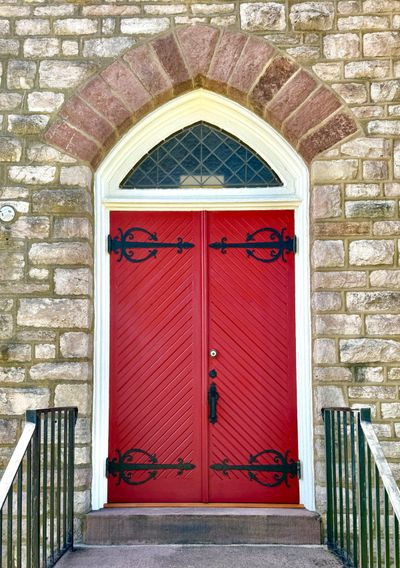
The main chapel entrance following restoration. Gothic pointed arch with brownstone voussoirs, leaded glass transom, restored chevron-panel double doors in traditional deep red. The ornate wrought iron strap hinges are original to the building.
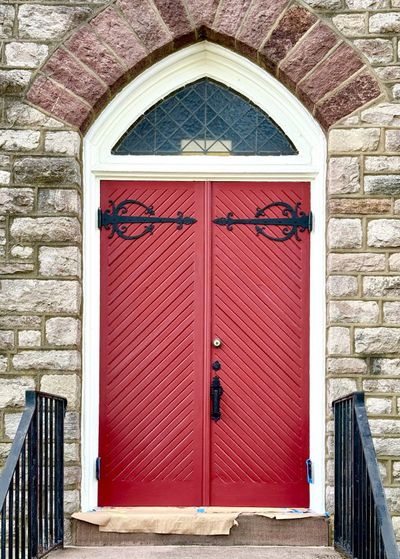
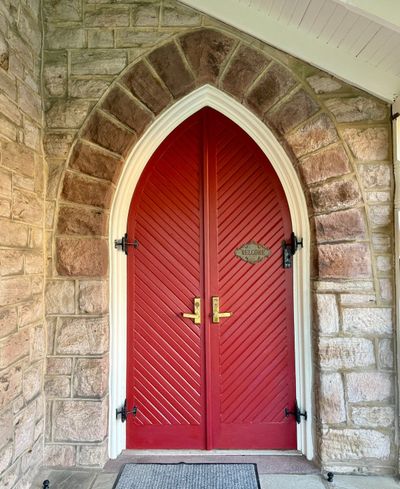
Multiple views of the restored chapel doors. Both sets of Gothic arch doors with their distinctive chevron plank patterns are now fully restored and functional. Original hardware preserved throughout.
When you finish a job like this, you're not just restoring a door. You're restoring a building's character — the visual anchor of its facade, the first impression you get when you approach. Those doors tell you something about the chapel's age and dignity. Getting them right matters. — Fred Beese, Fred Beese Builds
Questions About Historic Chapel Door Restoration
Frequently Asked Questions
How do you repair rotted wood in historic doors?
When wood rot has damaged the structural integrity of a door frame, the standard approach is to excavate all deteriorated material down to solid wood, then fill the cavity with epoxy consolidant like WoodEpox (Abatron) rather than simple filler. Epoxy consolidates and stabilizes remaining wood fibers while bonding to surrounding solid wood, restoring structural integrity. For severe cases involving bottom rails and stiles, compromised wood may need to be removed and new material spliced in, matching grain direction and wood species of the original. This is far more effective than patching and ensures the door will function properly for decades to come.
Can wrought iron hardware on historic chapel doors be preserved?
Yes. Original wrought iron strap hinges, hardware, and decorative elements can almost always be preserved, even when doors require extensive structural work. Wrought iron resists deterioration far better than wood and typically only needs cleaning, rust removal, and appropriate finishing. On the Blue Bell chapel restoration, all four original ornate strap hinges with scrollwork detailing were preserved through the entire project and reinstalled in their original locations. This is one of the key differentiators between thoughtful historic restoration and generic replacement — keeping what's original whenever possible.
How long do historically restored doors last after repair?
When restoration is done properly — addressing root causes like moisture wicking from stone thresholds, repairing structural damage with consolidants rather than fillers, and finishing with appropriate protective coatings — restored doors easily last 30+ years or more. The chapel doors in this case study have survived centuries; proper restoration ensures another century of service. The key is not just fixing visible damage, but understanding what caused it in the first place. Moisture wicking from stone foundations is one of the most common culprits in institutional buildings, and addressing this during restoration prevents recurrence.
What makes chapel and church door restoration different from residential doors?
Chapel and institutional doors face different challenges than residential doors. They often feature heavier-duty hardware, more ornate millwork, and are typically installed in stone masonry environments where moisture wicking and freeze-thaw cycles pose constant threats. They also carry greater historical significance — a chapel door might be a century or more older and contribute to the character of not just a home but a community landmark. Restoration requires understanding both the specific material challenges (like the moisture problems inherent in stone walls) and the historical importance of getting it right. Institutional building work also demonstrates a contractor's ability to work on commercial/public buildings, not just residential properties.
How is the chevron pattern on historic chapel doors restored?
The chevron (or herringbone) pattern common in historic chapel doors is achieved by laying planks diagonally at opposing angles, creating a distinctive geometric pattern. When doors with this pattern need restoration, each affected plank must be carefully assessed. Some may need full replacement if rot is extensive, while others can be consolidated in place. The pattern itself must be preserved exactly — any replacement planks are selected to match grain, color, and thickness, then installed maintaining the precise angle of the original pattern. Refinishing must be done uniformly across all planks to ensure the pattern reads as one cohesive design, not a patchwork of repairs.
Why is structural wood repair with epoxy consolidant better than wood filler?
Wood filler is a cosmetic solution that sits in rotted areas like spackle in drywall. It doesn't bond to surrounding wood, doesn't stabilize remaining fibers, and fails under stress. Epoxy consolidants like WoodEpox work differently: they penetrate deep into wood cells, chemically bonding with and stabilizing remaining wood fibers while also filling voids. The result is wood that's as hard and stable as the original, capable of supporting loads and withstanding movement. For structural elements like door bottom rails and stiles that must support the weight of the door and constant opening/closing stress, consolidation is the only appropriate solution. It's also the approach any professional restoration specialist would use on historic buildings.